How to evaluate wastewater, technologies, space, and costs to choose the right treatment plant for your business
Choosing a wastewater treatment plant for a small business means finding a solution that fits the production process, the characteristics of the water to be treated, and the requirements for discharge or reuse. The size of the facility alone isn’t enough to determine which system is the best fit. Even a small operation can generate wastewater with high pollutant concentrations or characteristics that vary throughout the day. That’s why flow rates, wastewater composition, available space, and operating costs need to be assessed before choosing a technology. IDRO Group designs custom industrial wastewater treatment plants, including compact and modular solutions, to meet the specific needs of each facility.
Which wastewater characteristics to assess before design
The first step in finding a wastewater treatment system for a small business is understanding how wastewater is generated and what substances it contains. Accurate characterization makes it possible to select the right treatment processes and size the plant correctly. It also reduces the risk of adopting a solution that is either inadequate or unnecessarily complex.
Four aspects in particular need to be analyzed:
- Flow rate and variability: the average volume of wastewater produced, peak flows, and fluctuations tied to work shifts, washdowns, or different production cycles.
- Wastewater composition: the presence of organic matter, suspended solids, oils, grease, metals, surfactants, or other specific contaminants. Parameters such as COD, BOD, and pH help define its characteristics.
- Final destination of the treated water: discharge to the sewer system or another authorized receiving body requires different considerations than recovering water for production use.
- Facility constraints: available space, the feasibility of civil works, access for maintenance, and the resources the company can dedicate to operating the plant.
These factors are closely interconnected. Wastewater produced in small quantities but with high pollutant concentrations or significant swings in quality may require more extensive treatment than a larger but steady flow. Testing should therefore reflect, as much as possible, the full range of the facility’s operating conditions.
What information to prepare before requesting a wastewater treatment plant
Before defining the plant design, companies can contact IDRO Group for a preliminary assessment and feasibility study. This helps identify which technologies to explore further based on production needs. To guide this phase effectively, it’s important to gather and share the following information:
- Description of operations and production cycles, indicating at which stages wastewater is generated and whether there are washdowns or intermittent discharges.
- Estimated flow rates, specifying average volumes and, where available, peak values and fluctuations over the course of the day or week.
- Wastewater analysis, including available parameters and information on substances used in the process, such as detergents, reagents, or chemicals.
- Treatment objective, clarifying whether the water will be discharged, and to which receiving body, or recovered for a specific use.
- Constraints and planned developments, such as available space, existing systems, installation requirements, and any planned production expansions.
IDRO Group provides water treatment consulting services and support throughout the assessment and design phases. When the available data isn’t sufficient to characterize the wastewater, any additional testing needed must also be identified before determining the final sizing of the plant.
Which wastewater treatment plant to choose based on your type of operation
Once the characteristics of the wastewater have been defined, the most suitable technologies can be identified. The challenges vary depending on the type of operation. Knowing the pollutants typical of your industry helps steer the design, although the final choice must always be based on analysis of the actual wastewater.
| Type of operation |
Main issues to assess |
Treatments to consider |
| Machine shops and metalworking |
Oils, suspended solids, metals, and substances used in machining processes |
Separation, physical-chemical treatment, and filtration |
| Food processing companies |
Organic load, grease, suspended solids, and pH fluctuations |
Pretreatment, equalization, and biological or physical-chemical treatment |
| Laundries and washing operations |
Surfactants, organic matter, and suspended solids |
Pretreatment, biological treatment, and filtration, depending on the wastewater |
| Small manufacturing operations |
Variable composition depending on raw materials and production cycles |
Custom treatment train based on testing and discharge objectives |
These guidelines are a starting point, not an automatic match between industry and technology. The solution must be defined based on pollutant concentrations, their treatability, and the required effluent quality.
Physical-chemical treatment to remove specific contaminants
When wastewater contains contaminants that need to be separated or transformed through dedicated processes, physical-chemical treatment may be considered. Depending on the composition of the wastewater, the treatment train may include pH adjustment, coagulation and flocculation, sedimentation, flotation, and filtration.
Not every plant requires all of these stages. The configuration is defined based on the pollutants present and the required performance, avoiding treatments that would not benefit the process.
Why equalization and pretreatment matter for variable wastewater
When production generates discharges at different times of day or with varying pollutant concentrations, it’s important to plan how to manage these fluctuations before the main treatment stage. A storage and equalization section can help ensure a more consistent feed to the plant, limiting swings in flow and pollutant load that could compromise process stability.
Pretreatment must also be selected based on the characteristics of the wastewater. Coarse solids, sand, oils, or grease may require preliminary separation to protect downstream stages and reduce the risk of clogging or malfunctions. The configuration depends on the wastewater: not every plant requires the same processes, and not every contaminant can be removed with a single treatment.
For a small business, considering these aspects from the start means looking not only at the quality of the treated water, but also at the plant’s ability to handle normal production fluctuations without constant corrective action.
Biological treatment for wastewater with a biodegradable organic load
If the wastewater contains biodegradable organic matter, biological treatment can be a core stage of the process. Technologies used include SBR (Sequencing Batch Reactor), MBBR (Moving Bed Biofilm Reactor), and MBR (Membrane Bioreactor), each with different characteristics.
SBR systems carry out the different treatment phases in sequence within the same reactor and can also be considered when pollutant loads vary. MBBR systems use mobile carriers on which biomass grows and can be integrated into modular plants. MBR systems combine biological treatment with membrane separation, improving suspended solids removal and helping achieve the water quality specified by the design.
The choice among these technologies depends on the biodegradability of the wastewater, pollutant concentrations, flow variations, and available space. It’s therefore important to evaluate the required performance together with operating conditions, rather than choosing a system based on its design features alone.
Filtration and polishing for discharge or reuse
In some cases, the main treatment must be followed by additional stages to achieve the required water quality. Sand and activated carbon filtration, ultrafiltration, reverse osmosis, and disinfection meet different needs and are selected according to the project objectives.
This assessment is especially important when a company plans to recover treated water for production use or other compatible applications. In these cases, the treatment train must be designed around the quality required for the intended use, while also accounting for energy consumption and the management of residues generated by treatment.
An application example: laundry wastewater treatment
One example of design based on wastewater characteristics is the plant IDRO Group built for Brunello Cucinelli to treat laundry wastewater, with a design flow rate of 40 m³ per day. The solution combines MBR membrane biological treatment, phosphorus removal, and final ozonation.
This project shows how different treatment stages can be combined to meet the specific needs of a production process. For a small business that generates wastewater from washing or processing operations, the design principle remains the same: analyze the wastewater composition and identify the necessary treatments, without automatically replicating configurations developed for different operations.
Compact and modular plants: when they’re right for a small business
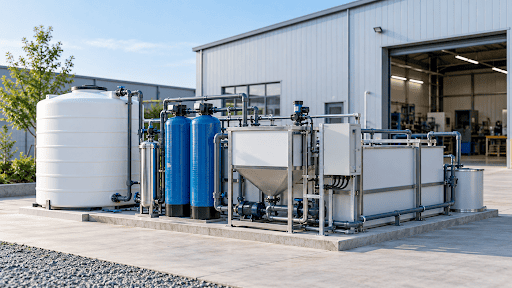
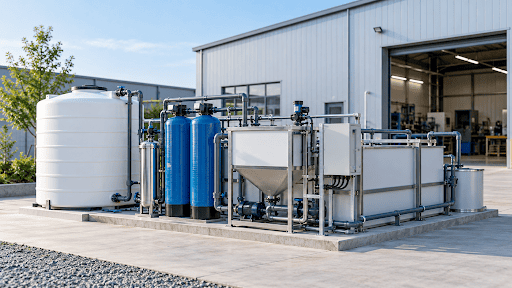
Beyond the treatment technology, a small business also needs to consider the plant’s footprint and installation requirements. When the facility has limited space or new civil works are impractical, a compact industrial wastewater treatment plant may be a solution worth exploring.
Prefabricated and containerized configurations integrate multiple treatment stages into organized, transportable units, simplifying installation and keeping the footprint compact, depending on the design. IDRO Group offers containerized plants and modular industrial wastewater treatment solutions, configured according to the hydraulic and pollutant load of the water to be treated.
Modularity can also be useful when future expansions are planned, as long as expansion options are considered during the design phase. Keep in mind, however, that a compact plant isn’t automatically the best choice for every small operation. It must deliver the required performance, allow for maintenance, and handle variations in the production process.
How to control operating costs and meet discharge limits
When evaluating whether a wastewater treatment plant is cost-effective, the upfront cost isn’t the only factor to consider. Energy consumption, the use of chemicals and filter media, maintenance, and sludge handling all affect the total cost of industrial wastewater management and should be evaluated during the design phase.
Another key consideration is discharge compliance. In Italy, Legislative Decree 152/2006 governs the protection of water from pollution and regulates wastewater discharges. The applicable permit and limits must be verified based on the characteristics of the wastewater, the final receiving body, local regulations, and the facility’s permit conditions.
Defining these requirements before choosing a plant makes it possible to identify a solution that meets applicable obligations and avoids later modifications caused by incomplete design. If water reuse is planned, the end use and required quality must also be determined, along with any need for additional polishing treatment.
How do you choose a wastewater treatment system for a small business?
The choice starts with analyzing flow rate, wastewater composition, production variability, and the limits that must be met. This data makes it possible to identify the right treatment process and size a plant that fits the company’s space and operational needs.
Is a compact plant enough for a small production operation?
Not necessarily. The size of the plant must be compatible with the volume and pollutant load to be treated. Even a small operation can generate concentrated or hard-to-treat wastewater that requires multiple treatment stages.
Can a wastewater treatment plant be installed without new civil works?
Compact and containerized solutions can reduce the amount of ancillary work required, but feasibility depends on the chosen configuration, utility connections, site conditions, and process requirements. These factors must be verified during the design phase.
IDRO Group: wastewater treatment solutions for small businesses
Choosing a wastewater treatment plant for a small business means striking the right balance between treatment quality, available space, discharge compliance, and operating costs. A thorough preliminary assessment makes it possible to define the necessary technologies and size a solution that fits production needs.
IDRO Group designs and builds industrial wastewater treatment plants using physical-chemical, biological, and membrane technologies, as well as compact and modular configurations. For facilities with limited space, Compact & Mobile solutions can also be considered for industrial wastewater treatment, as long as the configuration and sizing are based on wastewater characteristics, flow rate, and discharge or reuse objectives.
To find the right treatment for your facility, contact IDRO Group and explore our industrial wastewater treatment solutions, from purification to water recovery.